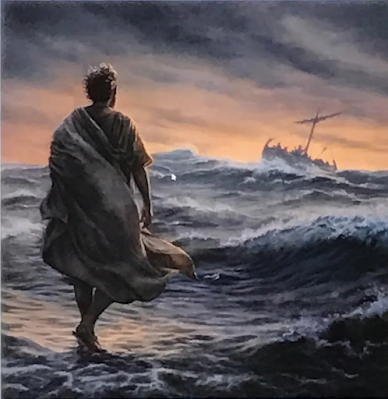
Thursday

Israel has Sinned. That’s Why They Cannot Stand

In my reading today, this stood out to me. I suspect that there’s a principle for me here. Maybe for your too.

Joshua 7: 11 “Israel has sinned; they have violated my covenant, which I commanded them to keep. They have taken some of the devoted things; they have stolen, they have lied, they have put them with their own possessions. 12 That is why the Israelites cannot stand against their enemies; they turn their backs and run because they have been made liable to destruction. I will not be with you anymore unless you destroy whatever among you is devoted to destruction.”

I don’t know about you, but I was taught that sin is bad because it scares God off from me. “God cannot look upon sin,” they said, completely ignoring the fact that “While we were yet sinners, Christ died for us.”

As my attention was grabbed by Joshua 7, I realized (yet again) that the big deal is the effect that sin has on me, NOT the silly idea that sin has an effect on God.

To summarize: “Israel has sinned; That is why the Israelites cannot stand against their enemies.” In other words, sin let failure into their lives, sin let their enemy beat them up, sin opened them up to what the enemy was doing, sin made them victims, not victors. 

God doesn’t like sin primarily because of the mess that it makes in our lives: it separates us from (in this example) victory, from our destiny as overcomers.

So when God says, “Be holy,” he’s not laying down the law. That’s largely about, “Position yourselves in the cross-hairs of my blessing!”

Jesus Freaks Out the Disciples

I've been reflecting on Hebrews 1, which tells us that Jesus is the best representation of God's nature we're ever going to get.

In that context, I'm thinking about Mark 6:48-50, yet another place where Jesus is representing Father’s nature.

"He saw the disciples straining at the oars, because the wind was against them. Shortly before dawn he went out to them, walking on the lake. He was about to pass by them, but when they saw him walking on the lake, they thought he was a ghost. They cried out, because they all saw him and were terrified. Immediately he spoke to them and said, "Take courage! It is I. Don't be afraid." Then he climbed into the boat with them, and the wind died down. They were completely amazed, for they had not understood about the loaves; their hearts were hardened."

This, too, is Jesus representing Father to us.

I observe some things here:

• Jesus saw his best friends straining at their work, because circumstances were against them, and he did not stop the events raging against them.

• Jesus let his friends struggle all through the night.

• I remember the aphorism, “It’s always darkest before the dawn.” So in the darkest part of the night, Jesus came to his friends. He still didn’t take the storm away, but he brought his presence to them in the midst of the storm. I love how he does this.

• He walks “out to them,” but “He was about to pass by them.” God does that sometimes: he comes to me, but … There are a hundred sermons in this line, but the bottom line is that he came “to them,” and he came close enough to see, but he was not stopping for them. That’s worth thinking about. “He was about to pass by them.”

• But his appearance scares them silly. God’s presence can be terrifying, if I’ve been focusing on the raging storm.

• He didn’t actually get in the boat with them until “They cried out.”

• We know from the other gospels that in here somewhere is the bit where Pete walks on the water, but it’s not in this particular gospel. While that’s a really exciting story (especially for Pete!), apparently that’s not the important lesson here.

• When Jesus gets into the boat, the storm dies down. Isn’t that how it goes?

• They were completely amazed. Duh. This one is not surprising!

• But the reason for their amazement, and maybe for their terror earlier, was because they didn’t understand God’s provision; they “had not understood about the loaves,” the story earlier in the chapter where Jesus “he had compassion” for the crowd of 5000 and taught them and fed them.

Apparently my not knowing God’s compassionate goodness leads to me being freaked out at circumstances, freaked out at his presence showing up unexpectedly, and leads to me being amazed when he changes things.

The last line teaches me that if I misunderstand God’s goodness, my heart gets hardened, and I’ll misunderstand what he’s doing. I might want to guard against this.

And the best way I can think of to guard against this is to be persistently thankful when I see him doing things. If nothing else, it helps me pay attention to what he's doing (so I’ll actually see what he’s doing), and it helps keep my heart in a healthy attitude toward him.

Led by Scripture?

This story has been bugging me:

Then he brought Him to Jerusalem, set Him on the pinnacle of the temple, and said to Him, "If You are the Son of God, throw Yourself down from here. "For it is written: 'He shall give His angels charge over you, To keep you,' "and, 'In their hands they shall bear you up, Lest you dash your foot against a stone.' " And Jesus answered and said to him, "It has been said, 'You shall not tempt the LORD your God.' " - Luke 4:9-12

I’ve been taught, and I’ll bet you have too, to base my choices and my requests on Scripture. If I can support it from the pages of the Bible, I’m safe.

This passage puts the lie to that. In this story, Luci asks Jesus to do something, AND HE SUPPORTS IT WITH SCRIPTURE! This is the secret code we’ve been taught to trust blindly, and the devil is using it to tempt Jesus! ðŸ˜²

In this story, it’s pretty clear that obeying this scriptural request was very much not God’s will:

Luci (the debbil) was the one making the request.
JC had a better understanding of the whole counsel of Scripture, and recognized that this use (with scripture!) violated the bigger issues.
Jesus only did what he saw Father doing (John 5:19), and apparently Father wasn’t showing off by skydiving from a clifftop, waiting for God to rescue him from the law of gravity and from the consequences of his own choice.
We could add that the quote (from Deuteronomy 8) was out of context, but the worst out-of-context quoter of Scripture that I know is Scripture itself. (But that’s another conversation).

I realize that I’ve done this. I’ve done this: I’ve taken verses as approval for my wishes and choices, and expected God to jump through my hoops. And then I’ve gotten angry or disappointed when he didn’t.

Principle: just because I can find somebody doing it in the Bible doesn’t mean it’s God’s will for my life. Or that it’s safe.

Principle: Yes, look for what Scripture says on the topic, but don’t stop there. Engage Holy Spirit, involve mature brothers & sisters.

Most importantly, know your Father’s heart, so when somebody tries to use Scripture to pull you away from his heart, you’ll know better and not follow that slimy trail.


Edification, Exhortation and Comfort: What Are They Really?

But he who prophesies speaks edification, exhortation and comfort to men.” - 1Corinthians 14:3

I’ve been chewing on this one for several months now. I’d like to invite you to process the verse with me.

At a fundamental level, this is the purpose of prophetic gifts: edification, exhortation and comfort, at least how it works under our New Covenant. (Old Covenant prophets were working from a different foundation, of course.)

When I studied the New Testament Greek in school, I learned that the last item in the series is the important one, the item that the language is emphasizing.

(Four verses earlier is a clear example of this: “And now abide faith, hope, love, these three; but the greatest of these is love.” The most important one in the list is usually the last one listed.)

And that’s how we’ve handled prophetic gifts most of the time, particularly when we’re training folks to prophesy: “Keep your prophetic words in the realm of edification, exhortation and especially comfort.” Then we hastily add, “Avoid judgment and avoid prophesying relationships at all times.”

But let’s look at these three purposes of the prophetic gifts a little more closely.

Comfort” Paul uses the Greek word “paramythia,” and one of its key meanings is what we expect. It describes talk for the purpose of “calming and consoling.” And this is how we often teach it in the prophetic.

The other use of “paramythia,” particularly as used in other Greek writings, also includes the idea of “persuading, or of arousing and stimulating,” though we have to get that from Plato, Socrates and Josephus, as this verse is the ONLY place that the Bible uses the word, so we don’t get much help from looking up how it’s used in other passages. Comforting, persuading, arousing, stimulating. (Since this is on social media, I suppose it needs to be said: this has no sexual connotations whatsoever.)

Exhortation” comes from the word “paraklÄ“sis,” which is closely related to “paraklete,” the word the New Testament uses for the Holy Spirit himself. We usually translate that word as “Comforter,” though in the prophetic, it’s usually in the context of “a calling near, summons,” or “supplication, entreaty,” or “admonition.” In other words, this is an action word, not a warm & fuzzy word. “Come on, let’s go” would be an example of a paraklÄ“sis word.

Edification” isn’t a word we use outside of church these days, but we’ve figured out that “oikodomÄ“ ” talks about the desire and act of building others up.

All of this thinking is happening in the context (both in my own mind, and if I understand right, in the Corinthian church Paul was writing to) of getting away from using Jeremiah and Ezekiel as our models for prophetic ministry. Nowadays, we think in terms of ’Miah and Zeke’s example on one end of the prophetic spectrum, and Precious Moments merchandise for our example on the other end.

My take-away from all this is along those lines. I’m not disrespecting the Old Covenant prophets, nor the Precious Moments business model, but I don’t believe either is an acceptable foundation or model for New Covenant prophetic ministry. And yet both contain at least a hint of the right elements for us.

My conclusion (at least this week) is that New Covenant people are not in the business of fire and brimstone, and that sort of judgment does not belong in our prophetic expressions. In fact, I tend to get up and walk out on those sort of proclamations (which is pretty much metaphorical in the context of social media: I won’t submit myself to that spirit).

The other end of that spectrum, for which I use Precious Moments as a metaphor, strikes me as less harmful to its audience, though it presents an image of the prophetic that is no better.

Those who define prophecy by either example are deceived and badly shortchanged.

Rather, legitimate prophecy does include elements of comforting folks going through a hard time, but rather than a “There, there!” and a pat on the hand, it also includes (in the vocabulary of 1Corinthians 10:13) “a way of escape, that you may be able to bear it.” It is not at all without sympathy (or empathy), but it most definitely doesn’t stop with that. And it certainly does not get in the way of personal responsibility.

And while legitimate prophecy completely avoids any vocabulary of God smiting or hating folks for what they’ve done (which was not uncommon under the Old Covenant), the concept of “You can do better,” or “Here’s the truth to replace the lie you’ve believed” is very appropriate, and is a solid example of “edification, exhortation and comfort to men.

Another way of describing that change of focus when calling people higher is this: “Don’t declare the problem. Anybody can do that. The evening news does a pretty good job. That takes no faith. Declare the solution. Declare the Good News. Declare God’s point of view of “a future and a hope.” (Jeremiah 29:11)


Praying to Stop an Untrustworthy Person

I was praying recently about a man who has shown himself to be untrustworthy and whose efforts to control the world around him have caused a lot of harm to a lot of people. It could have been any of a number of folks, I suppose.

“Father, stop him!” I prayed, and as soon as I said it, I knew I’d missed his heart.


Two things came quickly into my mind:

• The principle I’ve held for a few years that it’s easier to pray for the storm to change its path than to stop it altogether,

• The image of a man on his way to Damascus to persecute Christians getting knocked off his ass and turned from a persecutor into a preacher. “I didn’t stop him,” Father whispered.

And I realized that I need to change my prayer from “Stop him!” to “Change his path,” and even “Redeem him.”

As I considered this some more, it occurred to me that my Father is awfully good at redeeming irredeemable people, and bringing good through them who formerly brought evil.

I realized, not for the first time, that when I pray against people that Jesus died for, I’m doing it alone, not with my Father; that a much wiser path is to pray for the people and for their redemption.

I have permission to pray against their work if it’s hurting folks, but I have his presence and even his partnership as I pray for their redemption.


The Miracle Car

May I share a testimony with you?

For years, I’ve had an older Toyota sedan. Recently, through circumstances that aren’t part of this story, the car died, and we replaced it with the same model, but a year or two newer. (What can I say? I like some of the classic Toyotas.) I hadn't had a chance to sell the busted one yet.

Then the newer one died. My daughter was driving her sister home in it, and suddenly it seemed that the engine exploded: steam and smoke and scary noises burst from under the hood; the girls jumped from the car, steered it into a parking lot and called me to come rescue them.
 
I was able to drive it home, but just barely. It was horrible: it chugged and snorted and belched great clouds of white smoke and threatened to die on the half mile trip home. A friend looked at the engine and hung his head: “Cracked head,” he murmured, and shook his head. I was horrified: that wasn’t worth repairing.

Father whispered to me: “You’ve learned to trust me in circumstances where My provision comes before the problem does. Now can you trust me where you see the problem, but you don’t yet see My provision?” Hmm. This might be interesting.

Then we had a brainstorm! We could use the cylinder head from the dead car on the new car! That might work! Let’s look closely, and see if we can figure out how to do that!

So four of us gathered around to examine it. Only two of us had experience working on cars: one on a Honda, the other on a Volkswagen; the third guy & I could maybe change the oil, if we were desperate.

We lifted the hood. There was rust spattered all over the engine like blood, and I was sad all over again. “Well, let’s see where it’s cracked.” and we stuck the garden hose to the empty radiator. The idea was to fill the radiator, start the car, and see where the water leaked out: that was where the crack would be.

But before we could start the engine, we found the leak: a long crack on the top of the radiator! That was a much easier repair.

The four of us ran to the old car and checked: yep! Same size radiator. So over the next several hours, we removed both radiators, tested both radiators, and installed the one from the dead car into the living car, and filled it up. We started the engine: the same chugging and snorting and great clouds of smoke belched from the exhaust. How discouraging.

But then one of the guys pointed at the loose wires on the distributor, and asked, “Would that make a difference?” Two of the cylinders weren’t even firing. We re-attached those spark plug wires, and started the car again: it purred like a happy kitten.

I was floored. We’d gone from a completely dead car to a completely happy car in half a day, without spending a single dime. I’ve never seen that happen before!

Then Father reminded me: “Son, I’ve told you that I am your provision. Do you believe me?”

For the record: No, I don’t get every need met that way. The first car was still dead. And no, I don’t get all of my needs met in the way I want them met (like getting my classic car repaired for no cost at all!). But yes, I’m learning.

Prophets of Doom or Comfort Porn Prophets

Somebody asked me recently about whether if a prophet speaks of a trouble, are they a prophet of God or a prophet of doom? “It worries me,” she said, “that some people spend so much time promoting these ‘words’ that they become self-fulfilling.”

Fair enough.

From my viewpoint, this really is a legitimate concern. 

Having said that, to completely avoid any mention of trials, to become only a “warm and fuzzy prophet” (prophesying “comfort porn”) is equally errant. Both ditches are problems. And there are other “ditches” I suppose. 

Yeah, there are a *whole lot* of publicized “words” that seem to me to be motivated by marketing, by a need to be “relevant” or “cutting edge,” or are merely coming from what appears to be a wounded soul.
Fake news among the prophetic community?

Yeah, that’s why God gave us the gift of discernment. It’s probably more needful now than ever before.

I observe, however, that many Biblical revelations did, in fact, acknowledge coming trials. It’s easy to find this in the Old Covenant, and it’s easy (and often appropriate) to write many of those warnings off as ministering under an inferior covenant.

At the same time, most of the prophetic words to Paul during the latter part of the book of Acts fit that category as well; Agabus is never even hinted as being a false prophet. Even Jesus prophesied warnings; have you read Matthew 24 recently?

If a “prophet of God” is legitimately speaking about troubles, I’d argue that there are some ways to discuss that topic that are more appropriate than others. “The spirits of prophets are subject to prophets,” after all.

It seems that prophets need to speak what God is actually saying, not from other (lesser) voices/motivations. But those who hear the words have no less need to hear God as we discern those words.